


Album Review: Draconian - In Somnolent Ruin (Napalm Records, 2026)
Apr 25
7 min read
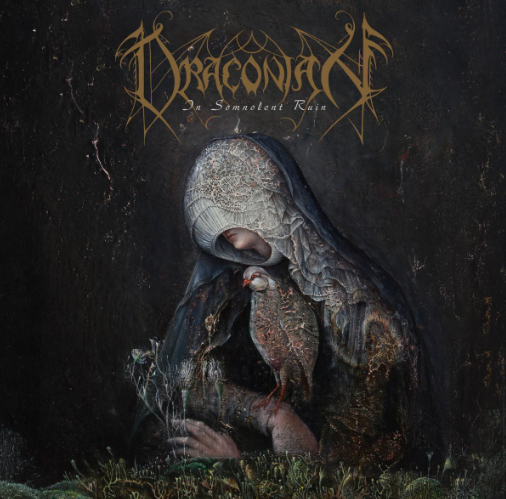
Written: 25th April 2026
Forming over thirty years ago, Draconian were one of the leading names in the second wave of Gothic Doom Metal and have continued to build on that legacy ever since. Their first five albums were recorded with vocalist Lisa Johansson before Heike Langhans took over for Sovran (2015) and Under A Godless Veil (2020). Now – on the band’s eighth album In Somnolent Ruin - Johansson has re-joined the band and when I interviewed guitarist Niklas Nord and growling vocalist Anders Jacobsson (read the interview here), the singer shared just how natural Lisa’s return felt. “It was like something familiar when she came back. With some people, even if you have barely seen them in ten years, it's like they’ve only been gone a few weeks and you pick up where you left off. It is definitely like that with Lisa. So it felt very familiar but in an updated kind of way because she's an even better artist and singer.”
Throughout their discography, Draconian have been an incredibly consistent band with each release rooted in their core identity while also allowing the band’s sonic template to evolve naturally. This is continued on In Somnolent Ruin which opens with the eight minute I Welcome Thy Arrow. Beginning with deep synths, a tolling bell and a hint of distant choral voices, it slowly unfolds, leading to the first beautifully fragile vocals from Lisa Johansson. You’re the hunter / I’m the haunted / Woven with sorrow’s thread / Where I go you will follow / I welcome thy arrow. After the last of these lines, the band join and a lamenting doom-laden riff descends. Transitions between sections have always been a strength of Draconian and In Somnolent Ruin is replete with such examples.
Naturally, there is melody too and the guitars of Niklas Nord and Johan Ericson intertwine with the vocals of not only Johansson but the powerful growls of Anders Jacobsson. Lush ethereal textures are balanced with heavier elements before both coalesce dramatically during the conclusion. Lyrically, I Welcome Thy Arrow confronts suffering with acceptance rather than resistance, allowing sorrow to become instructive rather than destructive. The indefinite chart / Of life’s spectral ocean… / But I was lost in woodlands / Famished and broken / Of what seemed like endless winter. Jacobsson comments, “It's like a dream state that song. It kind of prepares you a little bit for what's coming. I think it's a really good song to represent the album soundscape wise.” A slow-burner that gradually deepens, I Welcome Thy Arrow is a strong opener, establishing the album’s atmosphere while, in part, remaining deliberately restrained, suggesting heavier and more expansive moments to come.
The Monochrome Blade is instantly more intense and crunching riffs drive the song alongside some thunderous drumming from Daniel Johansson. Darker and more theatrical than I Welcome Thy Arrow, Lisa Johansson’s voice soars, while Anders Jacobsson’s growls bite with measured precision. When the dual vocals are in harmony, the pair’s innate understanding of each others' abilities shine through and together they conjure something quite majestic. The burden, the burden / The ancestral daughters and sons / The perilous ones / Is this what we’ve become? At this point in their career, Draconian are secure in using all the elements of their sound, moving from glacial and aching to spectral and metallic with ease. Strings, quieter introspective segments and colossal riffs are all utilised to great effect without any one aspect being overused.
Anima makes wonderful use of space and builds continually over its six and a half minutes. The different structural approaches to each song make In Somnolent Ruin an engaging album that presents the band’s music in a variety of ways. Swedish artist Daniel Änghede – who previously contributed vocals to Rivers Between Us on Sovran – sings in tandem with Lisa Johansson with whom he creates a grandiose partnership. Initially unhurried and imposing, Anima accelerates after four minutes and adopts a completely different persona. It captures the sense of being lost and questioning one’s place in the world. I lie awake with the rustlings / In the attic of my mind / The harrowing trauma paints the shadow that walks beside me. When all three voices combine at the song’s climax, it makes for one of the most dramatically moving segments of the whole album.
The Face of God – which depicts disillusionment with divine authority – is a contender for the best track here and has a multitude of both gothic and doom layers that long-time Draconian fans will welcome with open arms. Towering riffs collide with surging bass and drums on a tempestuous, hypnotic track that will surely find favour in the live arena. With a feeling of catharsis in his delivery, Jacobsson is at his most commanding and resolute. This cavern like a veil / Of a life thwarted and foiled / Unrealised in my sobriety. From gentle piano interludes to melancholic strings and haunting guitars to visceral double-kick percussion, fifth track I Gave You Wings – complete with different sections of spoken voice - is delightfully diverse in scope yet consistently cohesive. It is testament to the confidence that Draconian have in their approach and this is made all the more convincing by the excellent production values for which Niklas Nord credits Karl Lidén. “He has been mixing and mastering the album alongside Johan. Everything except the drums were recorded in Johan’s living room. It’s great what technology is available to us today. He's a magician. I don't know how he does it.”
The two-and-a-half-minute Asteria Beneath The Tranquil Sea serves as a transitional interlude and a change in atmosphere. Sung entirely by Lisa, it reinforces the album’s sense of contrast. A throbbing pulse, poignant strings and glorious synths accompany her expressive and captivating vocals. Cold Heavens – one of two songs already released - shatters this moment of calm.
Cold Heavens is the most straightforward song on the album, something that is entirely intentional as Johan Ericson explains. “In need of a more up-tempo song, Cold Heavens was the final piece written for In Somnolent Ruin. The intention was to create a simple track to balance the album’s longer compositions and add versatility.” When taken at face value and as a single, Cold Heavens lacks some of the depth that fans will be familiar with but the vocals by Johansson during the chorus are spine-tingling and it is great to hear her let loose in this way.
Interestingly, Anders Jacobsson told me, “On Under A Godless Veil, Lustrous Heart – the shortest song – was the first single. This time, Cold Heavens is the shortest song. It's kind of straightforward and that’s something labels usually want to start with because it's more in your face. You need to open someone’s eyes. I think it was a great single to do that. With the second single, you can sit back a bit a let it flow. Misanthrope River is more patient. I think that one represents the album the best. But on Cold Heavens, Lisa is really pouring it out!” As a result, Cold Heavens works extremely well within the flow of the album rather than as a standalone statement. Its more immediate structure provides a moment of directness amid the record’s broader, slower-moving compositions. Even if the band view it as one of their more pared-back pieces, it plays an important role in shaping the album’s overall pacing and balance.
Misanthrope River – another favourite of mine – begins with an ambient mood. Via spoken word from Simon Bibby, it leads us to the mysterious and minimalistic first verse. As the track progresses, emotional gothic-doom merges with hints of post-metal that further expand the areas that Draconian are exploring. Anders Jacobsson has stated that this album is one of his most personal from a lyrical perspective. “This time around, I was trying to be a little bit more elusive and introspective compared to the previous album for the listener to find themselves within it. But the lyrics, of course, are also about what's happening, what's happened in the last few years. It has affected me deeply. I care a lot about the social issues and everything. It also stagnated me in my creative process at times. I have my own issues, of course but I feel I'm very empathetic.” Misanthrope River is one of the tracks on In Somnolent Ruin that listeners may most readily associate with the band’s earlier sound; yet, it also shows how that foundation has evolved, with the songwriting feeling more refined and adventurous.
Final track Lethe draws on Greek mythology, the song centring on the River of Forgetfulness, where memory dissolves as a form of release. With beguiling, lilting rhythms, it serves as a dark lullaby questioning if peace lies in oblivion, faith or loss of self. Its ending is especially effective, built around a gently undulating rhythmic pattern that subtly rises and falls, creating the sensation of travelling along the river itself. In doing so, it brings In Somnolent Ruin to a deeply satisfying close.

In Somnolent Ruin is a natural continuation of the path Draconian set out on with Under A Godless Veil. Refining rather than rethinking their approach, it further strengthens a catalogue that has long been defined by consistency and depth. Lisa Johansson’s return is seamless, her presence entirely integrated rather than nostalgic, while the interplay with Anders Jacobsson remains one of the band’s defining strengths. As Jacobsson himself puts it, “We know what we are but we still want to be open to new influences. We also grow as people, as listeners and as artists. We need to be open to new inspirations. As long as you don't stagnate and try to repeat yourself, then I think it's fine to have a core identity.”
That outlook is clearly reflected here. At fifty‑eight minutes, there is - as always with Draconian - a great deal to absorb. However, across repeated listens, the album becomes increasingly immersive. This is Draconian in 2026: assured, expressive and unmistakably themselves.
In Somnolent Ruin is released on 8th May 2026


Comments